
Before you start
Evaluate a road-data validator against a representative delivery and a written requirements list. A demonstration that one file uploads successfully does not establish support for every TMH manual or every condition in your project. Ask for evidence at the level of file families, checks and review outcomes.
Start with the delivery you need to make
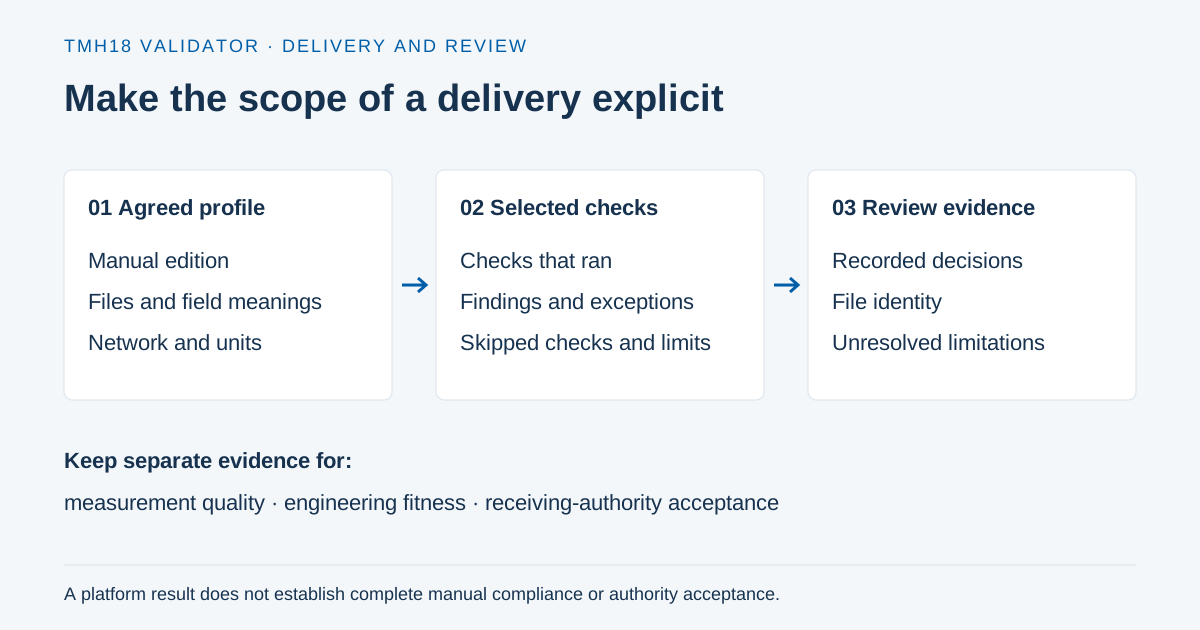
List the manuals and editions referenced by the contract, the expected files, the supplied road network and the receiving authority's acceptance process. Identify whether the task concerns condition data, traffic records, visual assessment summaries or a mix. Keep measurement and survey-method requirements alongside exchange-format requirements, with their respective owners.
Use synthetic or appropriately authorised test data for evaluation. Include a typical valid case, known format defects, missing values, duplicate candidates and network mismatches relevant to your workflow. Establish the expected result before running the files, so a pleasing dashboard does not become the acceptance criterion.
Ask what each check proves
Request a coverage list that distinguishes parsing, field validation, cross-record checks, network references and engineering review. Identify checks that depend on supplied data, settings or templates. Ask how the system reports skipped or unavailable checks. An unperformed check should not disappear into a general pass message.
Examine whether the system explains the rule, affected records and evidence well enough for another engineer to investigate. Compare the output with the known defects in your test set. Record unexpected passes as carefully as unexpected failures, because both affect confidence in the workflow.
Test correction and review
Follow a file from initial validation through correction, reprocessing and review. Confirm how the system connects findings to the exact file and template used. Check what happens to earlier review decisions when those inputs change. Review the permissions and separation of responsibilities required by your organisation.
Ask how exceptions are recorded and what evidence can accompany them. Test whether processing notes remain visible. A useful workflow helps reviewers explain a decision; it should not encourage users to change genuine measurements simply to obtain a clean result.
Check the handover and verification evidence
Inspect an example report and the associated file identity. Confirm how a receiving party obtains the applicable record and compares the delivered bytes with it. Distinguish a SHA-256 file digest from a per-person cryptographic signature and from an engineering assessment of the measurements.
Review export formats, data retrieval and the evidence retained after a project closes. Confirm commercial terms, limits and available integrations using current product information. Do not rely on an old article for a price, trial allowance or upload limit that may have changed.
Make the decision against explicit criteria
Score the tool against your required file families, the known-defect test set, review traceability, usability and handover requirements. Identify any external checks needed to complete the workflow. Document those gaps and their owners rather than using a single “TMH compliant” label for the whole evaluation.
TMH18 Validator can be evaluated through its current documentation, available check templates and the review workflow described in the learning library. Use the current pricing page for commercial details and the public verifier to understand the verification step. Confirm deployed coverage for your specific profile before treating a successful demonstration as project acceptance.
Sources and scope
- COTO TMH-18: Road Asset Data Electronic Exchange FormatsCommittee Draft 5.0, February 2016. Cover; §1.6, Table 5; §1.7, Table 6.
- COTO TMH-22: data integrityMarch 2013 draft (V8b source filename). §D.5.12, printed pages D-21–D-22: record counts, duplicates and matching key fields.
The cited sources describe their own requirements. Practical checklists and examples do not replace the receiving authority’s adopted profile. Platform review and certification are described in the product documentation.
Working templates
These working aids and synthetic examples are not official templates or evidence of complete compliance. Check each file’s stated scope before use.